

More people than ever are working from home — and many of them also happen to sew, craft, or run creative businesses on the side. That overlap has sparked a growing need for spaces that do double duty: somewhere you can hop on a Zoom call in the morning and cut fabric patterns in the afternoon without feeling like you’re living in chaos.
A sewing room and office combo sounds complicated, but with the right planning it can be one of the most functional and inspiring spaces in your home. The real challenge is keeping both zones feeling intentional — not like one activity always crowds out the other.
In this guide, you’ll find 15 creative sewing room office combo ideas, practical storage solutions, layout tips, and expert advice to help you design a multifunctional home office that actually works. Whether you have a full spare room or just a tidy corner to work with, there’s a setup here for you.
15 Inspiring Sewing Room and Office Combo Ideas
1. The Wall-to-Wall Workstation
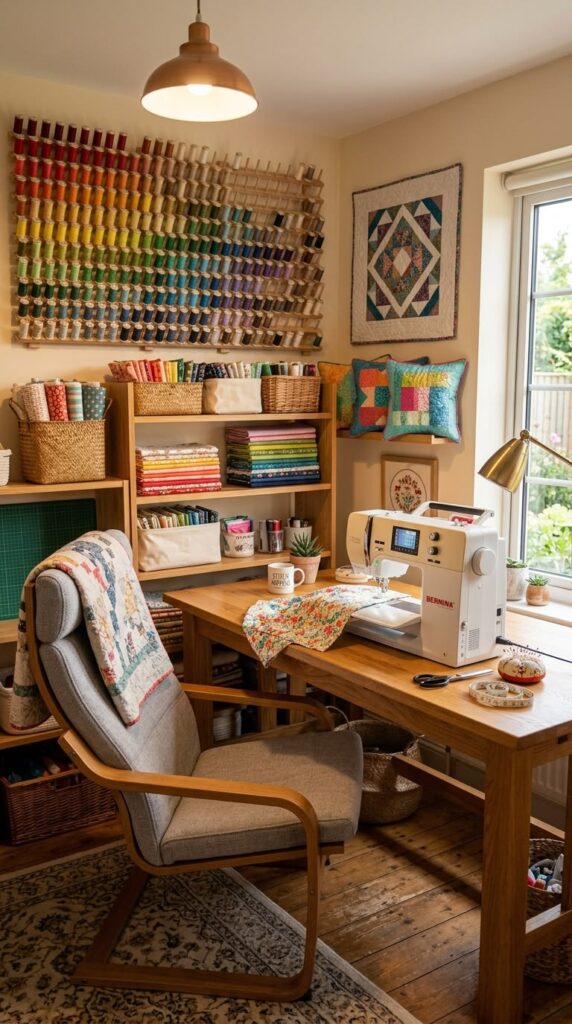
A wall-to-wall workstation turns an entire wall into your creative command center. One end holds your sewing machine, cutting mat, and thread storage. The other anchors your desk, monitor, and office essentials. A continuous countertop surface ties both zones together visually while giving you generous workspace throughout.
This setup works beautifully in narrow rooms where floor space is limited but wall length is generous. The horizontal flow keeps the room feeling open rather than cluttered. Add overhead cabinets above the full length of the counter for hidden storage that keeps both zones tidy.
Storage tip: Use matching cabinet fronts across the sewing and desk sections so the combo space feels cohesive rather than divided. Label bins inside cabinets so you can find tools quickly without digging.
2. Built-In Desk and Sewing Station
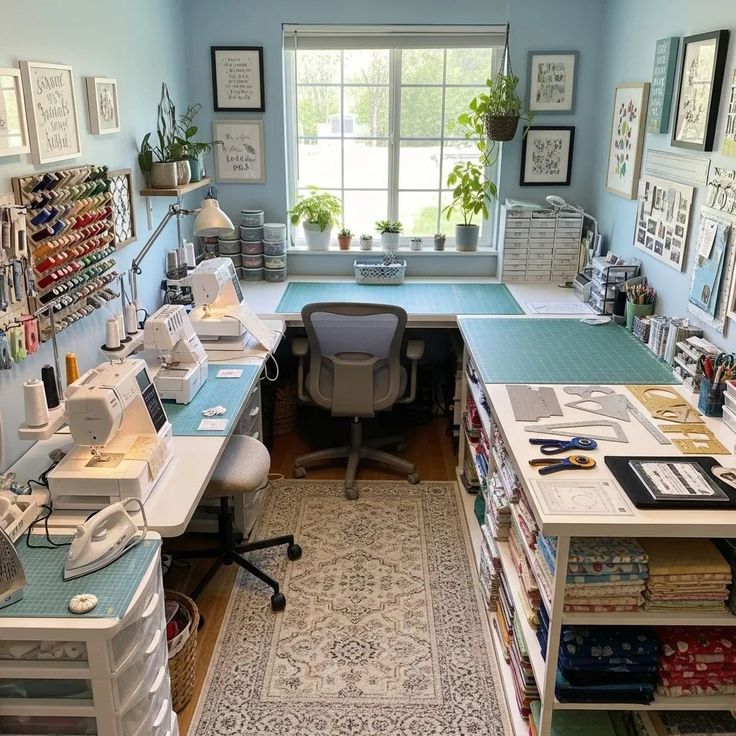
Custom built-ins are the gold standard for a home office craft room combo. A carpenter (or a confident DIYer) can design a built-in unit that houses a pull-out sewing machine shelf at counter height, integrated desk space, and floor-to-ceiling shelving in a single, seamless piece.
The pull-out sewing shelf is the real genius here — when you’re done sewing, the machine slides in flush and your office desk is clean and professional-looking for video calls. This is especially useful if your sewing room office is also your main workspace visible during meetings.
Design tip: Choose a built-in finish that matches your room’s trim or flooring for a high-end, intentional look. Recessed lighting underneath upper cabinets makes both the sewing and desk areas easier to work in.
3. Minimalist Sewing Office
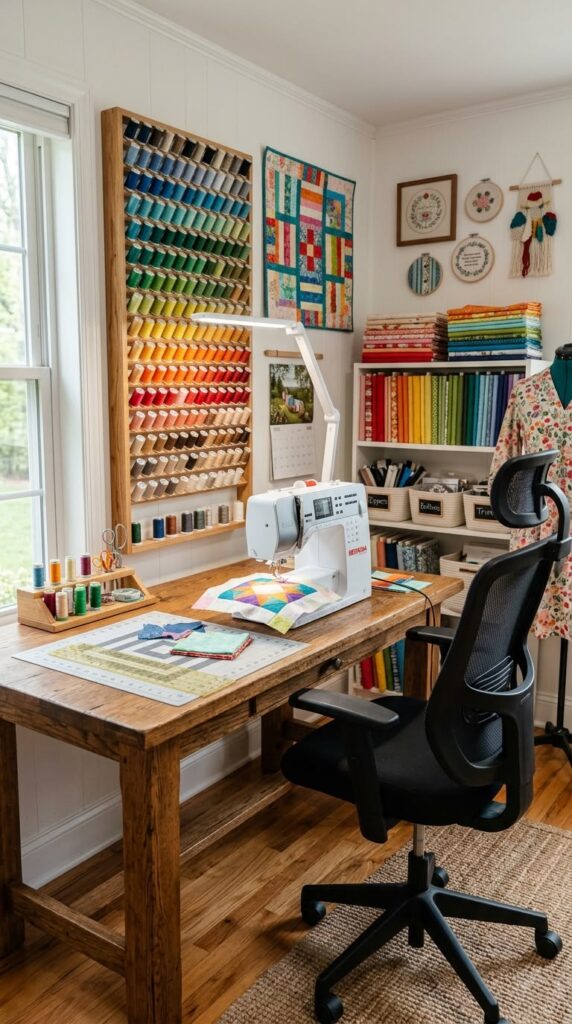
Not every creative professional wants their workspace covered in colorful spools and stacked fabric. A minimalist sewing office strips everything back to essentials — a sleek desk, one quality sewing machine, and a handful of well-chosen storage pieces with clean lines.
The minimalist approach works especially well in small or shared homes where visual clutter causes stress. Every item earns its place. Fabric gets stored in drawers or lidded bins instead of open shelves. Tools live in a single drawer organizer. The desk serves both purposes alternately rather than simultaneously.
Organization tip: Stick to a two or three-color palette — white, natural wood, and one accent color work well — to make the space feel curated rather than cluttered.
4. Double-Duty Corner Workspace
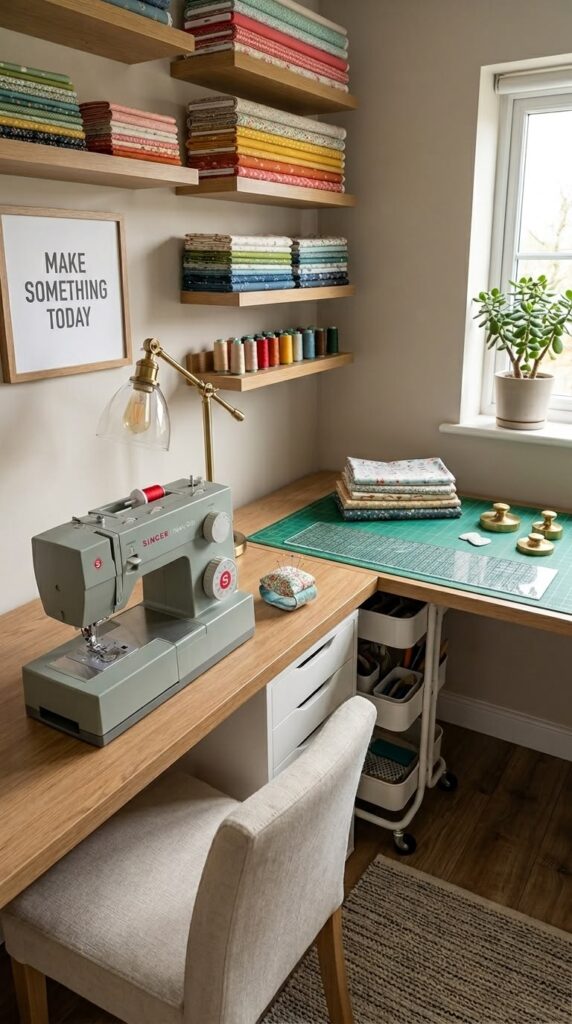
Corners are some of the most underused spaces in any room. A corner setup positions your sewing machine on one leg of an L-shaped desk and your computer on the other. You pivot between activities rather than moving across the room.
This layout is ideal for small bedrooms or bonus rooms where square footage is at a premium. The corner placement also gives you wall space on both sides for shelving, pegboards, or a pinboard — critical for a functional sewing room organization system.
Pro tip: Invest in a good swivel chair that rolls easily between both arms of the corner. This small detail makes switching between tasks feel smooth rather than disruptive.
5. Floating Shelves and Vertical Storage Setup
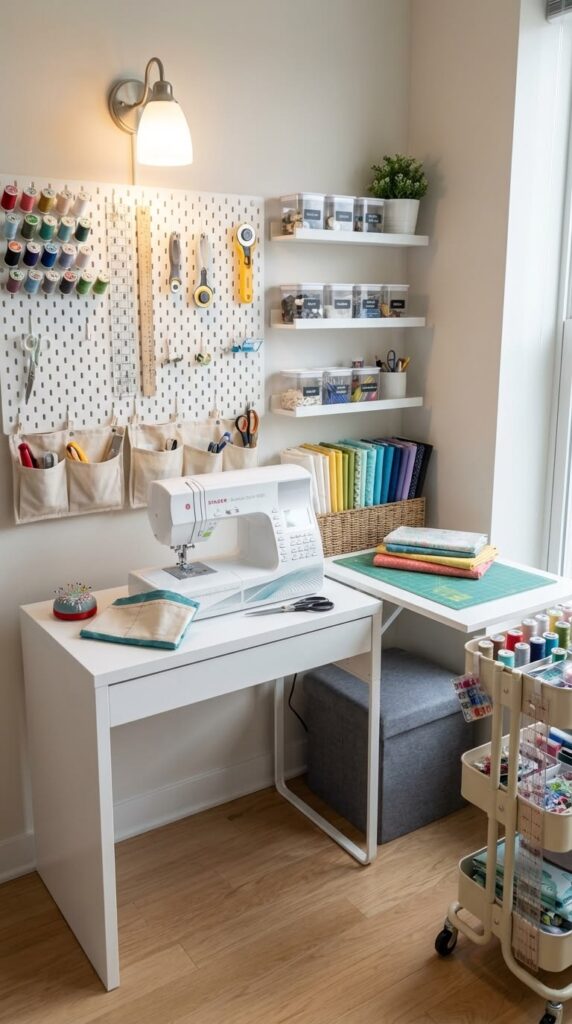
When floor space is tight, the solution is almost always to go vertical. A floating shelf setup runs shelves from desk height all the way to the ceiling, storing fabric bolts, thread, books, and office supplies in a single organized column.
This is one of the most budget-friendly sewing room storage solutions available. You can add shelves gradually as your collection grows, and the open design makes everything easy to see and access. Style your shelves by color or material for a Pinterest-worthy look that’s also genuinely functional.
Design tip: Use deep lower shelves for fabric bolts and bins, and shallower upper shelves for thread, trims, and decorative elements. Matching baskets on every other shelf add texture without chaos.
6. L-Shaped Productivity Hub
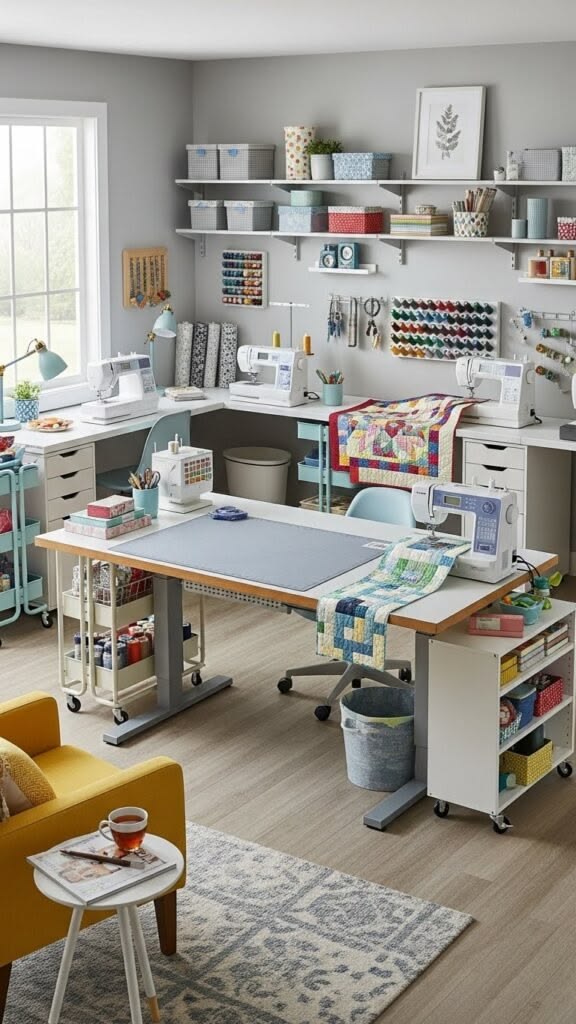
An L-shaped desk is one of the most popular layouts in creative workspace ideas because it naturally separates activities while keeping everything within arm’s reach. Position your sewing machine at one end, your computer at the other, and use the corner for a cutting mat or reference materials.
The L-shape creates natural zones without requiring a room divider or separate furniture. It also gives you a longer uninterrupted surface — essential when you’re spreading out pattern pieces or working on large fabric cuts.
Storage tip: The corner section of an L-shaped desk is often wasted. A lazy Susan organizer or a tiered shelf unit in that corner puts the space to work.
7. Closet Sewing Office Combo
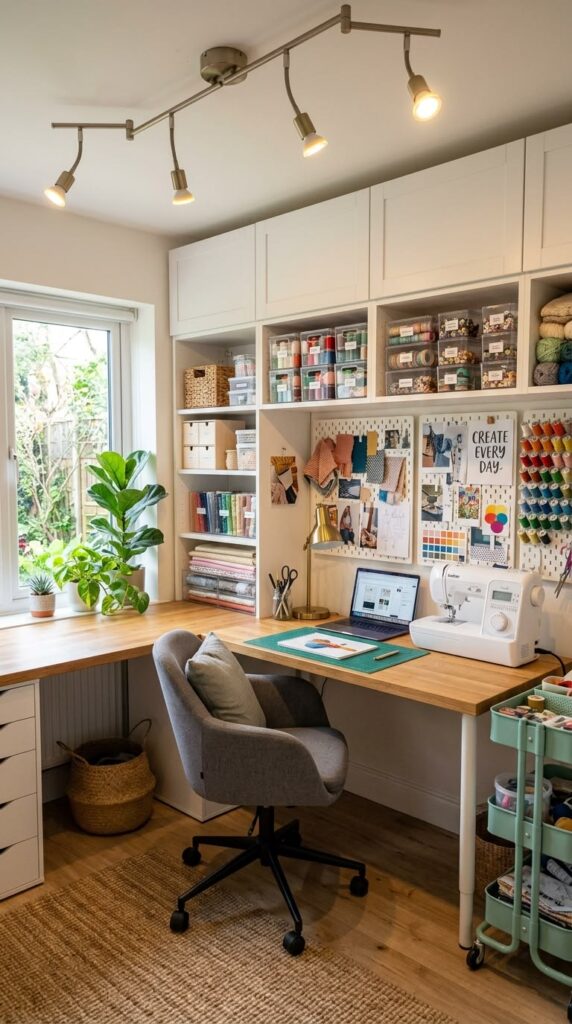
A reach-in or walk-in closet is one of the most exciting sewing room inspiration ideas for anyone short on space. Remove the hanging rod, add a custom desk surface and shelving, and you have a complete sewing-office nook that closes up neatly when you’re done.
Closet conversions work especially well in bedrooms. You get the creative workspace you need without sacrificing the feel of your living space. When guests visit, just close the doors. When you’re working, the enclosed feeling actually helps focus — it’s like having your own private studio.
Organization tip: Use the back of the closet doors for a pegboard or hanging organizer to maximize every inch of available surface.
8. Bright and Airy Creative Studio
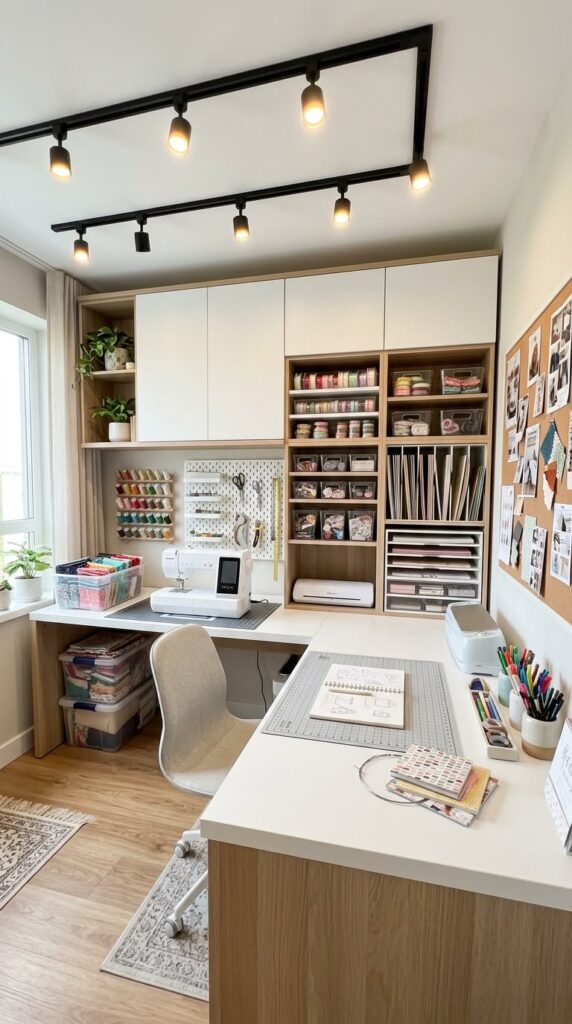
Natural light is one of the biggest productivity boosters in any workspace. A bright sewing studio idea positions your sewing machine and desk near windows to take full advantage of daylight — critical for accurate color matching in fabric work and for reducing eye strain during long office hours.
Pair large windows with sheer curtains that diffuse harsh afternoon sun without blocking light entirely. Light walls (white, soft grey, or pale sage) amplify natural brightness. Keep furniture low to avoid blocking window views and to maintain that open, airy feeling.
Design tip: Hang a large mirror opposite your primary window to double the light in the room without adding any fixtures.
9. Craft Cart Organization System
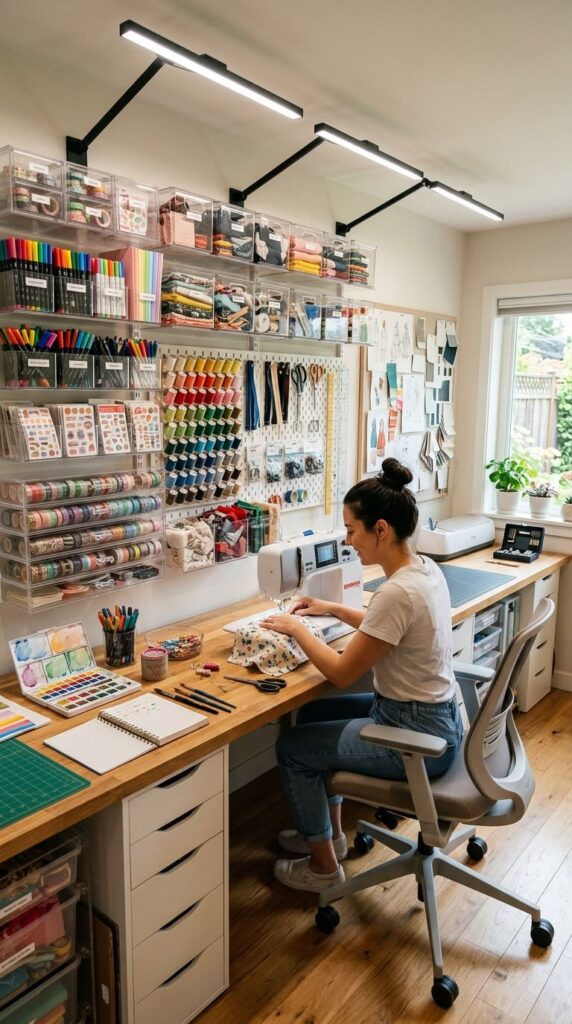
Rolling craft carts are one of the most flexible sewing room storage solutions available. A set of two or three tiered carts can hold your entire sewing kit — threads, scissors, pins, rulers, bobbins — and roll out when you’re working and tuck away under your desk when you’re not.
The cart system is particularly great for people who use their office space for multiple activities throughout the week. Nothing has to be permanently set up or broken down; your tools simply travel with you.
Pro tip: Assign one cart to sewing tools, one to office supplies, and one to current projects. Color-code the carts with washi tape labels so you never dig through the wrong one.
10. Small Room Space-Saving Layout
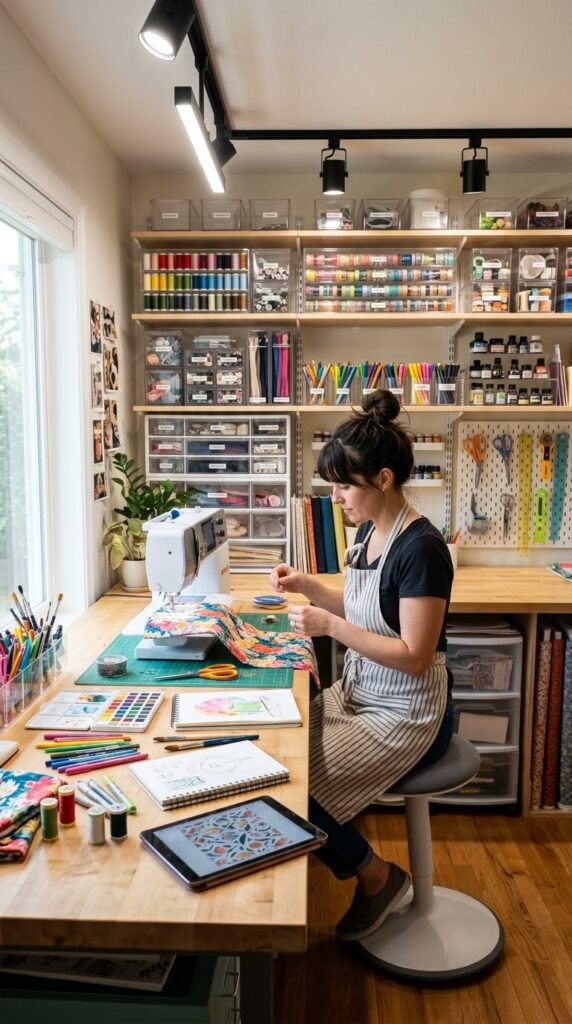
Designing a sewing room office combo in a small room requires serious intention. Every piece of furniture needs to earn its place. A fold-down wall desk is one of the best investments here — it serves as a cutting surface or office desk when open and disappears completely when closed.
Combine the fold-down desk with a wall-mounted sewing machine shelf and vertical pegboard storage, and you have a fully functional sewing studio that uses less than 20 square feet of floor space. Murphy-style storage concepts work brilliantly in small creative spaces.
Organization tip: Under-desk rolling drawers double as extra storage and don’t require additional floor space outside your existing desk footprint.
11. Modern Farmhouse Sewing Office
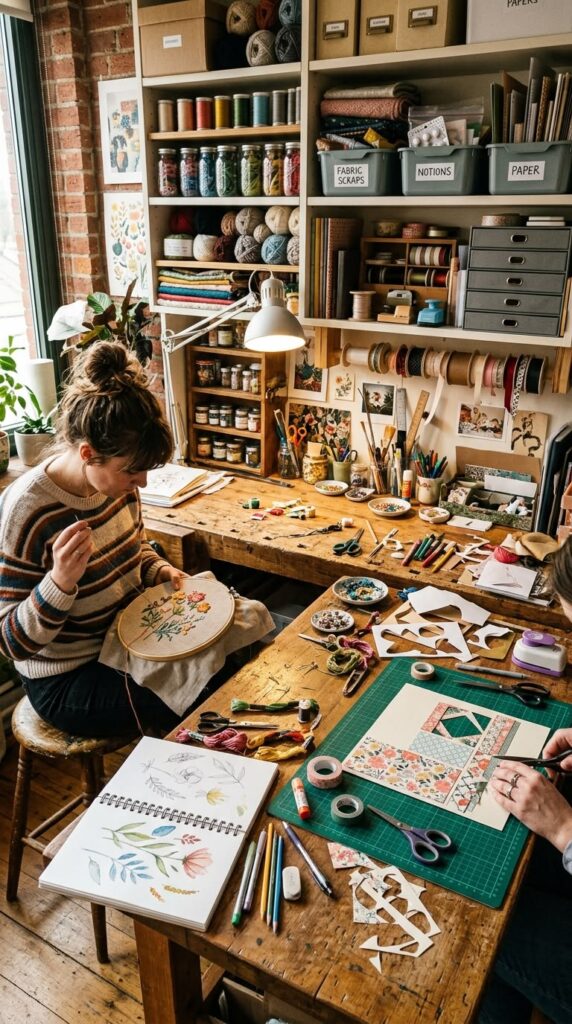
The modern farmhouse aesthetic translates beautifully into a craft room office. Think shiplap walls, open wood shelving, wicker baskets, a white-painted sewing table, and vintage-style task lighting. It’s warm and textural without being cluttered.
The farmhouse approach works well because the style celebrates handmade things — which aligns perfectly with a sewing studio. Antique thread spools in glass jars, a weathered wood cutting surface, and galvanized metal bins give the space character while remaining organized and functional.
Storage tip: Wicker and seagrass baskets are your best friends in a farmhouse-style space. They hide fabric scraps and supplies while adding warmth and texture to open shelving.
12. Pegboard Storage Command Center
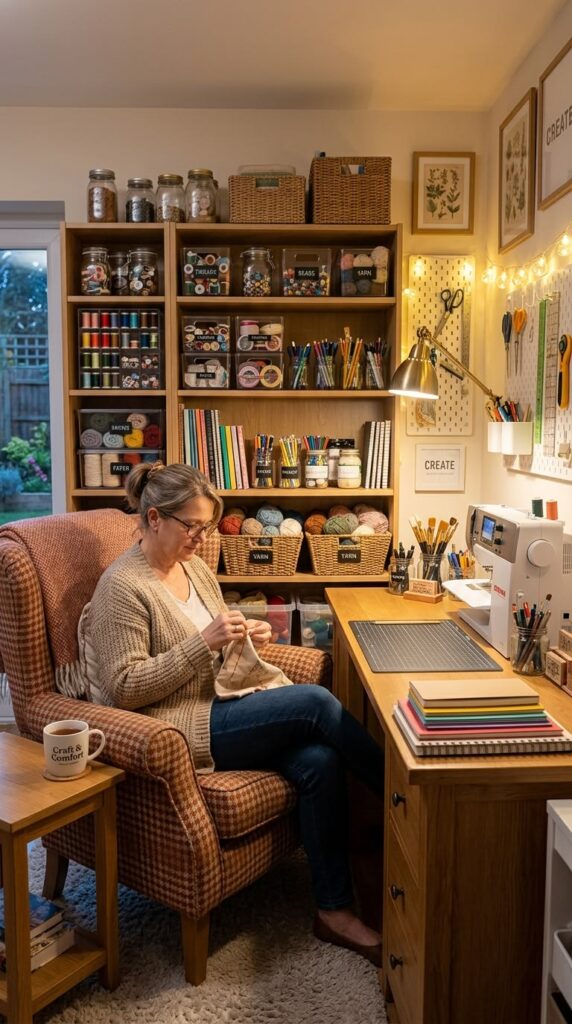
A full pegboard wall is one of the most beloved creative workspace ideas for sewists and crafters. It keeps every tool visible, accessible, and off your work surface. Hooks, bins, shelves, and holders can be rearranged at any time as your workflow evolves.
Mount your pegboard directly above your sewing table for maximum convenience. Hang scissors, rulers, rotary cutters, measuring tape, and thread all within arm’s reach. The visual organization also saves significant time — you never dig through a drawer hunting for a seam ripper again.
Design tip: Paint your pegboard an accent color — deep teal, terracotta, or matte black — to make it a design feature rather than just a utility wall.
13. Shared Family Workspace
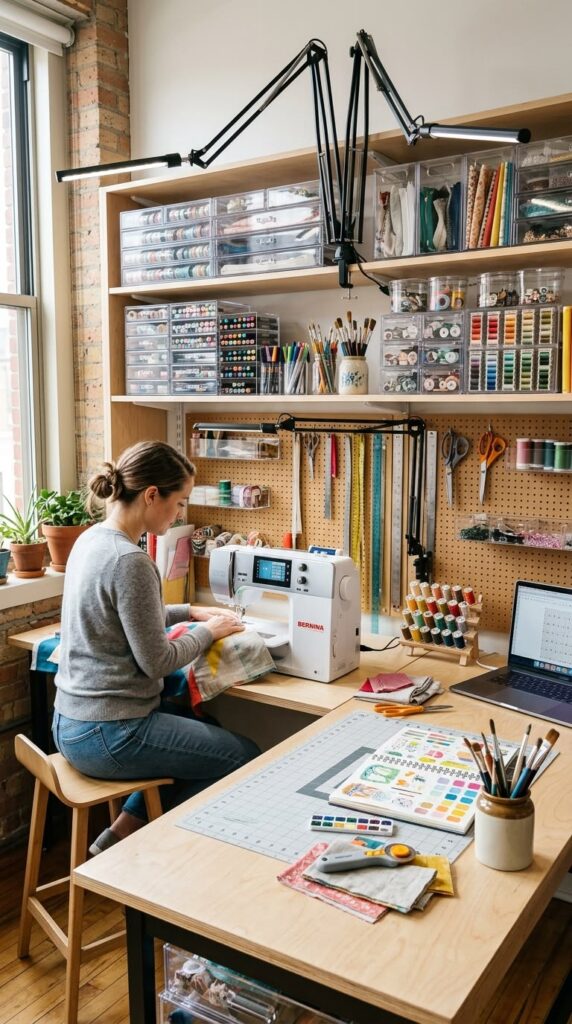
If you share your home office craft room combo with a partner, child, or family member, zoning becomes even more important. Divide the room visually using a bookshelf as a room divider, or designate one side of a double-sided desk for sewing and one for general office work.
Clear communication about zones and shared storage reduces friction significantly. A shared space works best when each person has dedicated drawers or shelves that are exclusively theirs — no overlap, no “where did my scissors go” moments.
Pro tip: If a child is sharing the space, choose furniture with rounded edges and keep sharp tools like rotary cutters in a locked drawer or high out of reach.
14. Luxury Sewing Studio Office
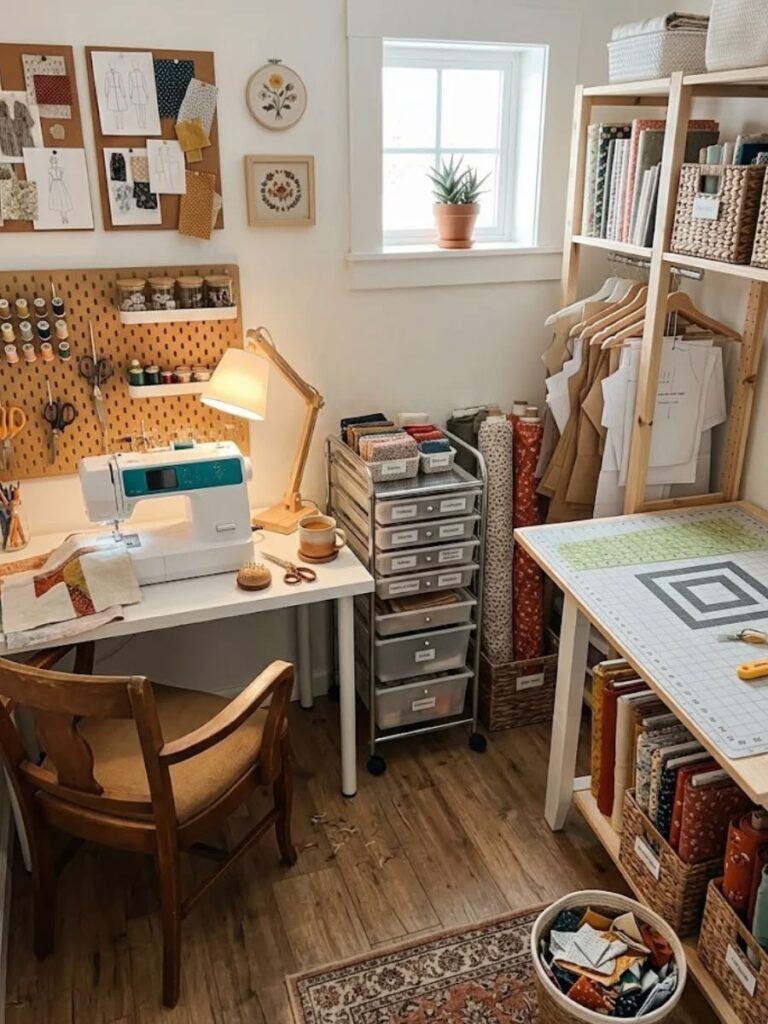
For creative professionals who want their sewing room inspiration to lean toward the aspirational, a luxury setup prioritizes quality materials, thoughtful lighting, and custom furniture. Think custom cabinetry with soft-close drawers, a dedicated pressing station with a built-in iron holder, a professional cutting table at proper height, and a separate high-end desk setup.
Luxury doesn’t have to mean maximalist. The most impressive sewing studios are often beautifully organized with everything in its place. Quality over quantity applies to both tools and decor.
Design tip: Add a small seating area — a single armchair with a good reading lamp — for pattern review, sketching, or client meetings if you run a sewing-based business from home.
15. Pinterest-Worthy Creative Command Center
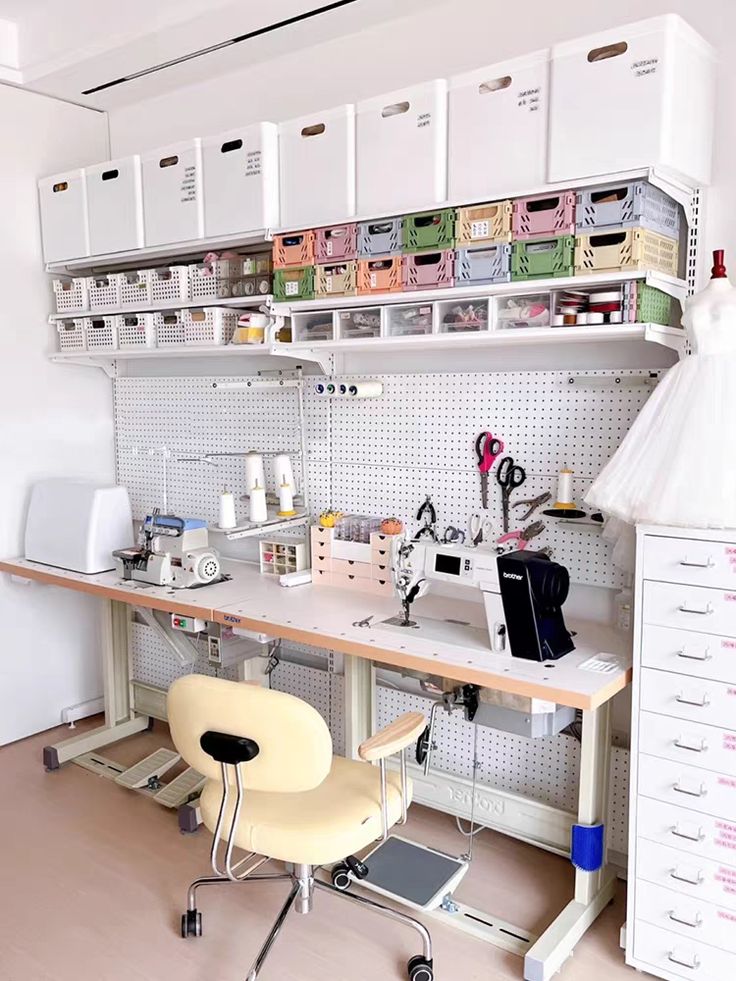
This is the setup that stops scrollers mid-feed. A Pinterest-worthy creative command center combines perfect symmetry, a cohesive color palette, beautifully labeled storage, and layered lighting into a space that looks like it belongs in a magazine.
Matching glass jars filled with colorful thread, fabric organized by color in open cubbies, a custom neon sign above your desk, macramé wall hangings alongside functional pegboards — this setup is both deeply personal and highly Instagrammable. The key is making every organizational choice a design choice at the same time.
Pro tip: If you’re setting up a space you want to photograph and share, natural light is non-negotiable. Pair it with warm-toned ambient lighting for evenings and you’ll have a studio that looks incredible at any hour.
Essential Features Every Sewing Room Office Combo Needs
No matter which layout or aesthetic you choose, a well-designed sewing room office combo always includes these foundational elements.
Lighting: Poor lighting is the fastest way to ruin both your productivity and your sewing accuracy. Layer three types: ambient overhead lighting, task lighting directly above your sewing machine (an LED swing arm lamp is ideal), and natural light if at all possible. Daylight-balanced bulbs (5000K–6500K) are best for color-accurate fabric work.
Ergonomic Seating: You’ll likely spend hours in this room. A proper ergonomic chair with lumbar support is not optional — it protects your back and improves your focus. Make sure it’s adjustable to work at both desk height and sewing table height if those differ.
Cable Management: Nothing destroys the aesthetic of a beautiful creative workspace like a tangle of visible cords. Use cable clips, raceways, or under-desk cable trays to route computer cables neatly. A power strip with individual switches lets you turn off sections of your workspace without unplugging everything.
Fabric Storage: Fabric needs a dedicated home. Options include clear bins on open shelves (great for visibility), flat folds in cubbies, or rolled bolts on a wall-mounted dowel. Whatever system you choose, organize by color or project type so you can find what you need quickly.
Tool Organization: Scissors, rotary cutters, seam rippers, pins, and rulers all need designated spots. Pegboards, magnetic strips, and drawer dividers are all effective. The golden rule: every tool has one home and always goes back to it.
Workspace Zoning: Even in a small room, use visual or physical cues to define your sewing zone and your office zone. This might be a different desk lamp, a change in floor mat, or simply dedicated sides of the room. Clear zones reduce the mental friction of switching between tasks.
Storage Solutions That Keep Creativity Organized
Cabinets: Floor-to-ceiling cabinets with solid doors are the ultimate storage workhorse. They keep fabric, supplies, and tools completely hidden, making your space look clean and professional even during your most creative seasons.
Rolling Carts: Flexible, affordable, and endlessly reconfigurable. Rolling carts work for every budget and can be added one at a time as your storage needs grow.
Pegboards: The hero of the open-storage world. Pegboards are infinitely customizable, highly visual, and surprisingly beautiful when styled intentionally. Paint them a bold color to double as wall art.
Drawers: Deep drawers with dividers are perfect for flat-fold fabric, notions, and office supplies. Soft-close drawer systems feel luxurious and last for years.
Labeling Systems: A label maker is one of the best investments you’ll make. Labeled bins, drawers, and shelves save time, reduce frustration, and make it easy for anyone else in your household to return borrowed items correctly.
Hidden Storage Ideas: Ottomans with storage lids, benches with lift-up seats, and hollow cutting tables are brilliant for tucking away large or irregular items that don’t fit standard shelving.
Common Mistakes to Avoid
Poor Lighting: Most home offices and craft rooms are dramatically underlighted. One overhead fixture is almost never enough. Add task lighting at your sewing machine and desk, and consider under-shelf lighting if you work with detailed fabrics or fine thread colors.
Insufficient Storage: Creative professionals almost always underestimate how much storage they need. Plan for twice the storage you think you currently need — your collection of fabric, tools, and supplies will grow, and running out of storage space after your setup is complete is deeply frustrating.
Mixing Work Zones: Allowing sewing supplies to creep onto your office desk (or vice versa) is one of the most common problems in a home office craft room combo. It creates visual noise, slows you down, and makes you feel perpetually disorganized. Maintain firm zone boundaries even when you’re in a hurry.
Ignoring Ergonomics: Hunching over a sewing machine that’s too low, or squinting at a monitor that’s not at eye level, causes real physical strain over time. Position your sewing table at elbow height when seated and your monitor at eye level with no neck tilt.
Clutter Accumulation: Creative spaces attract clutter because every project generates scraps, swatches, and half-finished experiments. Build regular tidying into your workflow — a 10-minute reset at the end of every work session keeps accumulation from becoming overwhelming.
Expert Tips for Designing a Productive Creative Space
Design for your actual workflow, not an imagined one: Before buying any furniture, spend a week tracking how you actually use your time. Do you sew every day or once a week? Do you take video calls regularly? Your layout should serve your real habits, not an idealized version of them.
Invest in good task lighting first: Of all the upgrades you can make to a sewing room office, lighting delivers the biggest improvement for the lowest cost. A quality LED sewing lamp costs less than $50 and dramatically reduces eye strain and error.
Use your vertical space aggressively: Most people stop adding storage at eye level. The space between eye level and ceiling is often completely unused — and it’s ideal for storing seasonal fabric collections, finished project storage, or less-frequently used tools.
Create a daily reset routine: End each work session by putting everything back in its designated spot. This five-minute habit prevents the slow creep of clutter that can make a beautiful creative space feel chaotic within weeks.
Add personal inspiration to the walls: Whether it’s fabric swatches from projects you loved, mood board prints, or even creative gifts and décor from people who inspire you — surrounding yourself with meaningful objects improves motivation and creative output. Much like how thoughtful decor transforms event spaces (the same design principles that make banquet table centerpieces memorable work in personal creative studios too), your workspace should feel intentionally designed and personally meaningful.
Plan for future growth: Whether you’re expanding your sewing business, taking on more remote work, or simply accumulating more fabric over time, build flexibility into your storage and layout. Modular shelving systems and rolling furniture give you room to adapt.
Don’t neglect comfort and ambiance: A scented candle, a small plant, or a favorite playlist playing softly can transform a purely functional room into a place you genuinely want to spend time. Creative work flourishes in environments that feel welcoming.
Consider the people who inspire your creative journey: Just as teachers and mentors deserve recognition for their influence — something explored in ideas for meaningful gifts that acknowledge someone’s guidance — your workspace can honor the makers and designers who have shaped your craft through books, samples, and curated displays.
Conclusion
A well-designed sewing room and office combo is one of the most rewarding creative investments you can make in your home. It’s the kind of space that makes you want to sit down and work — whether that means opening your laptop for a morning of emails or spending an afternoon deep in a new sewing project.
The 15 ideas in this guide cover everything from minimalist closet studios to luxury custom-built rooms, from budget-friendly cart systems to Pinterest-worthy command centers. But the most important principle in all of them is the same: design for how you actually work, not how you imagine you might.
Start with your layout, define your zones, invest in proper lighting and storage, and let the aesthetics build naturally from there. Your creative workspace should reflect your personality, support your productivity, and make both work and craft feel genuinely enjoyable.
The best sewing room office combo isn’t the most expensive one or the most photogenic one — it’s the one you can’t wait to use every single day.


